Posts

TECHNOLOGY IN SPORTS: CRICKET
Image
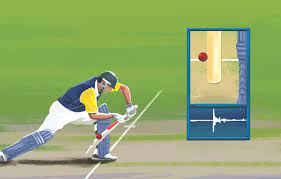
TECHNOLOGY IN SPORTS: CRICKET So as we are approaching the ICC worldcup which will be hosted by India this year, let us address one of the very common questions that most people get while watching this sport. How do the umpires use Snicko and Hotspot? SNICKO: The Snickometer, more commonly called the Snicko, or as we call it, the Ultra-edge, is used to check whether the ball has edged the bat or glove in some way, during the judgement of dismissals of Leg Before Wicket, or Caught behind.  The Snickometer was invented by English computer scientist Allan Plaskett in the mid-1990s. The snickometer was introduced by Channel 4 in the UK, who also introduced the Hawk-Eye and the Red Zone, in 1999.  So how does this work?  The Snickometer uses a very sensitive mic attached to the stumps which is connected to an oscilloscope that measures the sound waves. The mic captures the sound at the moment when the ball nicks the bat. The sound is amplified and filtered out to certain frequ...

Image
  Change is Scary, but it can be beautiful too!   We have always been hearing all our life that, change is the only constant in life, how ironic, change and constant together in one sentence. Our own beloved Shri Krishna in Shrimad Bhagwat Gita has said, “ परिवर्तन   ही   संसार   का   नियम   है” Change is the law of life.  We all have been through this process every now and then, willingly, and unwillingly. Credits: Steve Greer Photography, Literary Hub The other day, I had a conversation with a friend of mine who had to move to Chennai due to a job requirement. This move from Pune to Chennai was a big change as it was moving to a new place, new environment, and new faces, it almost changes everything for her indeed a transformative experience that affected almost every aspect of her life. Initially, she was scared, although she didn’t openly admit it. Sensing her restlessness, I respected her space and allowed her to process her emotions. As the ...

Lithium-Ion Batteries Recycling

Image
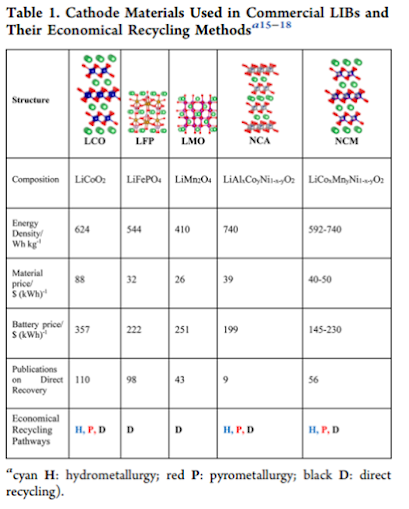
Lithium-ion Battery Recycling   Introduction and uses: Lithium-ion batteries are amongst the most commonly used in the world, with the usage varying from handheld small electronic devices such as electronics, toys, wireless headphones to electric cars and energy storage systems we use today. These batteries are greatly preferred due to their high energy density, i.e. the ability to store energy efficiently in a given amount of space. Lithium batteries are smaller and lighter than other types of batteries, and have a greater energy density, leading to its greater use compared to other kinds of batteries. Lithium cells are of two types- one made of lithium metal which are single use and non-rechargeable, and the other which are made out of lithium and polymer and are multi use and non-rechargeable.   Structure of a li-ion battery: A lithium-ion battery comprises of a cathode, an anode and an electrolyte. The anode is usually made of carbon(graphite), the cathode of a...

Numerical Investigation on Heat Sink Material for Temperature Control of Electronics

Image
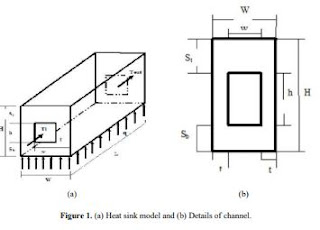
  Introduction:   The advancement of technology has led to the development of electronic devices that are becoming increasingly complex and powerful. However, with this increase in power comes an increase in heat generation, which can lead to device failure if not managed properly. This is where heat sink materials come into play. In this blog, we will discuss the findings of a recent study titled "Numerical Investigation on Heat Sink Material for Temperature Control of Electronics" and how it contributes to the field of thermal management. Background:   The study was conducted by Shankar Durgam, Bharati Ghodake, and Suhas Mohite from the Department of Mechanical Engineering at the College of Engineering Pune in India. The researchers investigated different heat sink materials for their effectiveness in enhancing heat transfer and cooling electronic devices. The cooling medium used for analysis was water. Findings: The study found that advanced heat sink materials can sig...
Image
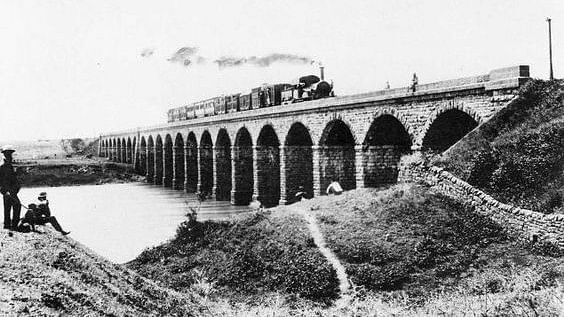
  INDIAN RAILWAY: LIFELINE THE TO NATION   Chapter 1: The Rise   On April 16th, 1853 (Chaitra Shukla Saptami, Shake 1775) , a historic moment took place in India's transportation history. The first passenger train in India ran between Mumbai and Thane, covering a distance of 34 kilometers. This was the birth of Indian Railways, which today stands as one of the largest railway networks in the world. As we celebrate the 170th anniversary of this significant event, let us take a journey through the history of Indian Railways.                 Pic Credit: The train, travelling from Bori Bunder (CST) to Tannah (Thane), left the station at precisely 3.30 pm on 16 April, 1853. (Photo courtesy: Pinterest)   The idea of a railway system in India was first proposed in 1832 by Warren Hastings, the Governor-General of India. However, it was only in 1844 that the first railway company, the Great Indian Peninsula Railway (GIPR...